Showing posts with label stained. Show all posts

Sunday, January 11, 2015

Soldering tip: How to keep the solder from running through to the back

In this short video I show how to keep the solder from running through small gaps to the back of the piece.

When making a large stained glass panel there are usually some small spots where the pieces don't quite line up perfectly and small gaps appear.  These tiny gaps sometimes result in a small pool of solder on the back side of the piece.  An easy way to overcome this problem is to snip small sections of copper wire to fill the small gaps with.

I use reclaimed electrical wire salvaged from a house that was demolished.  I stripped the sheathing from the wire with a knife and use the wire cutters on my needle nosed pliers to cut it to length.  If you have a gap that runs the length of the piece, you can cut the wire to length and bend it to fit; or, if the gap is just in a small corner, you can just cut a tiny little nub of wire to fill the spot.  as long as the wire does not have a coating on it, fluxing it will allow the solder to stick to it and not pass through to the other side.  I use this technique when the holes are not very big:  if the gaps are too big, I'll re-cut the piece to fit.

Thursday, January 8, 2015

Stained glass Christus


 I was asked to do a stained glass picture of the Christus statue originally sculpted by Bertel Thorvaldsen for my wife's Aunt.  A replica stands in the LDS visitor's center at Temple Square in Salt Lake City. That version is surrounded by a wall mural of space with stars and planets. This picture reflects on that background. I have used little glass bobbles as stars. The panel is 24 inches tall and 18 inched wide and has 154 pieces and is done in the Tiffany style of copper foil and solder.  My wife's aunt said that her husband would make the frame to match their existing decor if I were to make the light box.  I will try and get some pictures of the piece once it is in place at their house with the frame on.  This was a fun commission with surprisingly few pieces.  If you are interested in purchasing one, contact me.


Tuesday, September 9, 2014

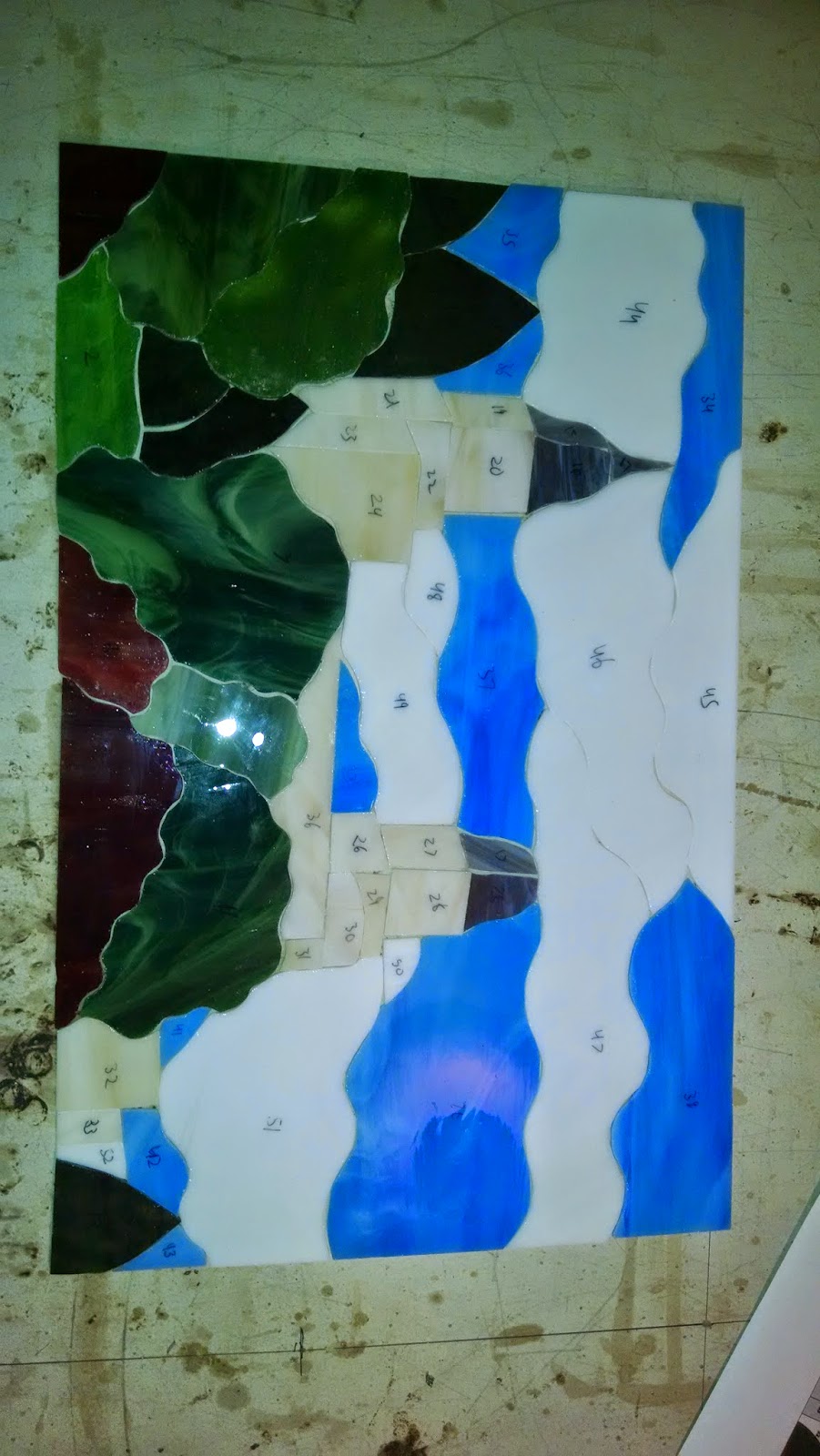
Small Manti Temple Stained Glass for a Boy Scout Fund Raiser Auction Piece


This is a small stained glass picture of the Manti Utah temple that I made for an auction for the Boy Scouts in my ward.  It is a little smaller than my regular temples at just under 17" x 11"  Sorry about the orientation of the pictures, I'm going to try and fix them when I get more time.  This was the first picture I deliberately made very squiggly lines.  I think it adds a lot to the picture especially when there are limited pieces like in this piece.


Saturday, August 16, 2014

Stained Glass Timpanogos Temple


Here is a stained glass picture of the LDS Timpanogos Temple.  The glass is 44" tall by 33 1/2" wide.  The frame ads about 5 inches to each side.  It has over 830 pieces.  It is the biggest single piece I have done (the door doesn't count because it was made up of 10 pannels)  It has a light box included and can be plugged in to light it up.  This item is for sale!.  I have finally had some time to make some stained glass that I can sell instead of giving away for a wedding  or Christmas present.  I'll be putting this in the Sanpete County fair and then in the Utah State Fair so that I can hopefully drum up some business.

Update:  This piece won "Best In Show" at the Utah State Fair  this fall.  That was exciting.  It is now for sale on my Etsy store.

Thursday, June 27, 2013

Two Tools In One: Stained Glass


I have been working a lot on stained glass lately and thought it might be helpful to show you how I have made my glass cutting more efficient.  I do this by taping my grozer pliers to my glass cutter.  Now this only works with the pistol grip pliers, but I like it a lot.  It only took me a few minutes of using them together like this and I was hooked.  I don't see them as two tools anymore, I go from cutting to nipping with ease and without even thinking about it.

No more dropping one tool to pick up the next, and then dropping that one to go back to the first.  This trick has saved me lots of time and probably some arthritis.  I know it has saved my ears.  All that tool dropping can get loud.

I used blue painting tape because I just wanted to see if it would work and wanted to be able to peel it off if it didn't work well.  Apparently it works great because it has been over a year of using the tools like this and I haven't even thought of replacing the tape.

Try it out and let me know how it works for you.  If you are an entrepreneur and are able to fabricate something like this into a single tool, go ahead, by all means, do it.  But, please send me a pair, cuz remember folks, you saw it here first. 

Wednesday, January 4, 2012

Stained Glass Bountiful Utah Temple


This year for Christmas we had Sarah’s brother Joseph and his family to give presents to.  So, following the traditions of previous years, I made them a stained glass picture of the Bountiful Utah Temple where they were married.  I wasn’t able to use much recycled glass on this one, only the windows, but I was able to put to good use some of the wood floor we have been salvaging to use as a frame.  The floor boards are tongue and groove.  The stained glass fit nicely into the groove.  So, I sanded off the old paint, trimmed off the tongue side, routed an edge on it and turned it into a picture frame.


 Another innovation this piece has on it are a couple of female ends to chain locks.  I have been struggling to find a secure way to hang heavy stained glass on a wall and I hope this will finally be the solution.


 I bought an LED light bar from IKEA to mount on the back.  The problem is that there is n o sign at IKEA that says that when you buy an LED light strip, you have to buy a plug to go with it.  So, I don’t have any pictures with the light working.   In fact, I haven’t seen it work yet.  We sent the plug to them after the picture was delivered and haven’t had a chance to see the whole ensemble together.


Look Ma, no plug

Thursday, January 27, 2011

Glass Color

People often ask me how I get my glass to be the right color. Some people ask me if I paint the glass or if I add chemicals to the glass. So I'm going to explain here about recycled glass colors. Let me first off say that even though I can often be found with a variety of liquor bottles in my possession, I don't drink alcohol. However, alcohol bottles are the most abundant type of bottle out there and come in the biggest variety of colors. That’s right; I get my colors from the bottles themselves.


There are a few ways stained glass gets its color. First of all normal glass is clear which is very convenient because it would be weird to look out of colored glass windows all the time. To get different colors of glass manufacturers add metal oxides to a batch of molten glass. Different metal oxides in different ratios produce the myriad of colors that you see in stained glass. These colors can range between opaque to clear, dark and light and everything in between. There are several companies out there that specialize in producing consistent colors for use in art glass.

This is a good time to talk about compatibility. The companies that make art glass usually try and make their glass compatible. This means that two different pieces will fuse together when heated and when they cool they will maintain a congruent, cohesive bond. Basically glass expands as it is heated and as it cools it contracts. Depending on the chemical makeup of the glass, i.e. the different metal oxides mixed in, the glass may expand and contract at different rates. If you try and fuse two pieces of glass that are not compatible, they will expand and contract at different rates and a cohesive bond will not form resulting in cracking and in extreme cases explosions. The trick here is to produce glass that is not only compatible, but also in a range of colors. The swirly colors seen in a lot of stained glass is produced in this way.

Bottle and window manufacturers don’t care if their glass is compatible with others, they only care if their glass finishes out structurally and visually sound. This is why people usually don’t fuse recycled glass; it just isn’t compatible. Because some of the metal oxides required to get certain colors are expensive (silver and gold for example) there are several colors that you will rarely see in “throw away” liquor bottles. Reds, yellows, oranges, and purples are rare in bottles and are usually reserved for art glass or more expensive containers and vases.

Another way glass is colored is by painting it with fuseable glass. If you look at stained glass in churches and see faces that look like they are painted it is because they are. Don’t be fooled into thinking that this is a cheap trick because it usually isn’t. Specially trained glass painters practice for years to learn to paint with enamels on glass. Enamels are basically powered glass. The artist will paint on the glass and then fire the glass in a kiln to fuse the enamel onto the glass. The end product truly is “stained glass” that won’t scrape off and can’t be washed off.

The last way glass is colored is by painting it with regular paint. This is the cheapest and worst way to color glass. Basically the glass is painted with normal paint, and that’s all. This kind of paint will eventually come off because there is no chemical bond to adhere it to the glass. If you were to put painted glass in a kiln it would burn of the paint and you will get a dirty clear glass as a result.

As a result of all this, I have a limited pallet of colored glass to choose from. Most of my glass comes from bottles including the ones shown here. (No, I am not endorsing any of them.) Sometimes I use different colored (usually white) light sconces. To get the hard to find colors I search the thrift stores for vases, plates, cups, etc. Everything I use has to be cut with my saw and then fired flat in the kiln before I can use it in stained glass.


Tuesday, October 26, 2010

Manti Temple

Stained Glass Manti Temple


Trees in front of the temple
I finally finished it!  After a long and time consuming marathon of stained glass, I was finally able to finish the stained glass picture of the LDS Manti Temple.  This beauty took over 80 hours of work, but I was able to get it done in about a month.  The temple is made of light sconces I melted flat, the windows, roof, and trees are also recycled bottles I melted flat.  The sky and grass are made of salvaged stained glass I bought.  Even the frame is made of salvaged molding. 


Manti Temple west tower with light rays

This is by far the biggest, most difficult, and most rewarding piece I have made so far.  It has just over 500 pieces in it. 
Unfortunately there is no income off of this one; it was a wedding present for my brother-in-law and his new wife…they had better like it ;)  I hope to be able to start making more large pictures like this one soon.